
Two years ago, AI lived in a browser tab. You opened ChatGPT in Chrome, typed a question, copied the answer and closed the tab. To WhatPulse, that looked like "Chrome" (before we added Web Insights at the beginning of 2026).
Then the AI companies started shipping real desktop apps. ChatGPT came to the Mac. Anthropic launched Claude for desktop. AI code editors like Cursor and Antigravity replaced VS Code on a lot of machines. Suddenly these tools had their own window, their own process and their own row in the WhatPulse application stats.
That gives us something most AI usage reports can only estimate: how much people actually type into AI apps. Not downloads, not sign-ups, not survey answers. Keystrokes and time, counted on real desktops, every hour, for almost three years.
Here's what 33 months of data say.
The short version
| January 2024 | September 2026 | |
|---|---|---|
| Active WhatPulse users who typed into a desktop AI app | 0.7% | 21.3% |
| AI keystrokes per active WhatPulse user | 34 | 4,863 |
| Share of all keystrokes going to AI apps | 0.01% | 1.90% |
| Time spent in AI apps per AI user | 1.7 hours | 16.2 hours |
In January 2024, fewer than 1 in 100 active WhatPulse users had a desktop AI app they typed into. By September 2026, more than 1 in 5 did. The average WhatPulse user now types 143 times as much into AI apps as they did at the start of 2024, and AI's share of everything people type went from a rounding error to almost 2%.
Two percent doesn't sound like much until you remember what's in the other 98%: every email, every Slack message, every line of code, every game. Almost one in every fifty keystrokes now goes into an AI app.
How we measured this
WhatPulse counts keystrokes, clicks and active time per application, per hour, on every computer running the client. For this article we:
- followed the same group every month: everyone who was active on WhatPulse that month, about 12,000 to 13,000 people, from January 2024 to September 2026;
- grouped all builds of each app into one product, so "Claude" covers every Mac and Windows build of the Claude desktop app;
- only counted native desktop apps. AI you use in a browser tab counts as your browser, so the real numbers are higher than these.
WhatPulse users are not a cross-section of everyone. They're people who spend a lot of time at a computer: developers, gamers, writers, power users. That makes them an early signal. When their habits change, everyone else's tend to follow.
We never see what anyone types, only how often a key is pressed and in which app.
2024: AI moves to the desktop
At the start of 2024, about 1 in 250 active WhatPulse users typed into a desktop ChatGPT app, and only a handful had tried an early AI code editor called Cursor.
Two things happened that year.
ChatGPT became an app. In May 2024, OpenAI released ChatGPT for macOS. That month, ChatGPT desktop's reach among active WhatPulse users quadrupled, from 0.3% to 1.1%. It never went back down.
Developers found Cursor. In the summer of 2024, Cursor took off. Monthly keystrokes went from about 500,000 in June to 3.1 million in September. By August 2024, Cursor had passed ChatGPT to become the AI app people typed into most, and it held that spot in 17 of the next 20 months.
Then, at the end of October 2024, Anthropic released the Claude desktop app. In its first month, it reached a quarter of a percent of active WhatPulse users. Modest, but it was the start of the biggest story in this dataset.
2025: everyone gets an AI app
In 2025, desktop AI went from early adopters to normal. The share of active WhatPulse users with an AI app nearly doubled, from 7% in January to 13% in December, and new apps kept arriving:
- February 2025: 1.4% of active WhatPulse users installed a local LLM app (LM Studio or Ollama) in a single month, the biggest wave of "run AI on my own machine" in our data.
- July 2025: Perplexity launched Comet, its AI browser. At its peak in October 2025, it reached 4% of active WhatPulse users.
- October 2025: OpenAI launched ChatGPT Atlas, its AI browser. Within ten days, 1.4% of active WhatPulse users had it running.
- November 2025: Google launched Antigravity, its AI code editor. 1.4% of active WhatPulse users installed it in its first month.
Meanwhile the "big three" settled into a pattern. Cursor and ChatGPT each saw around 10 million keystrokes a month. Claude was a solid but distant third, at around 1 to 2 million.
That didn't last.
2026: the year of Claude
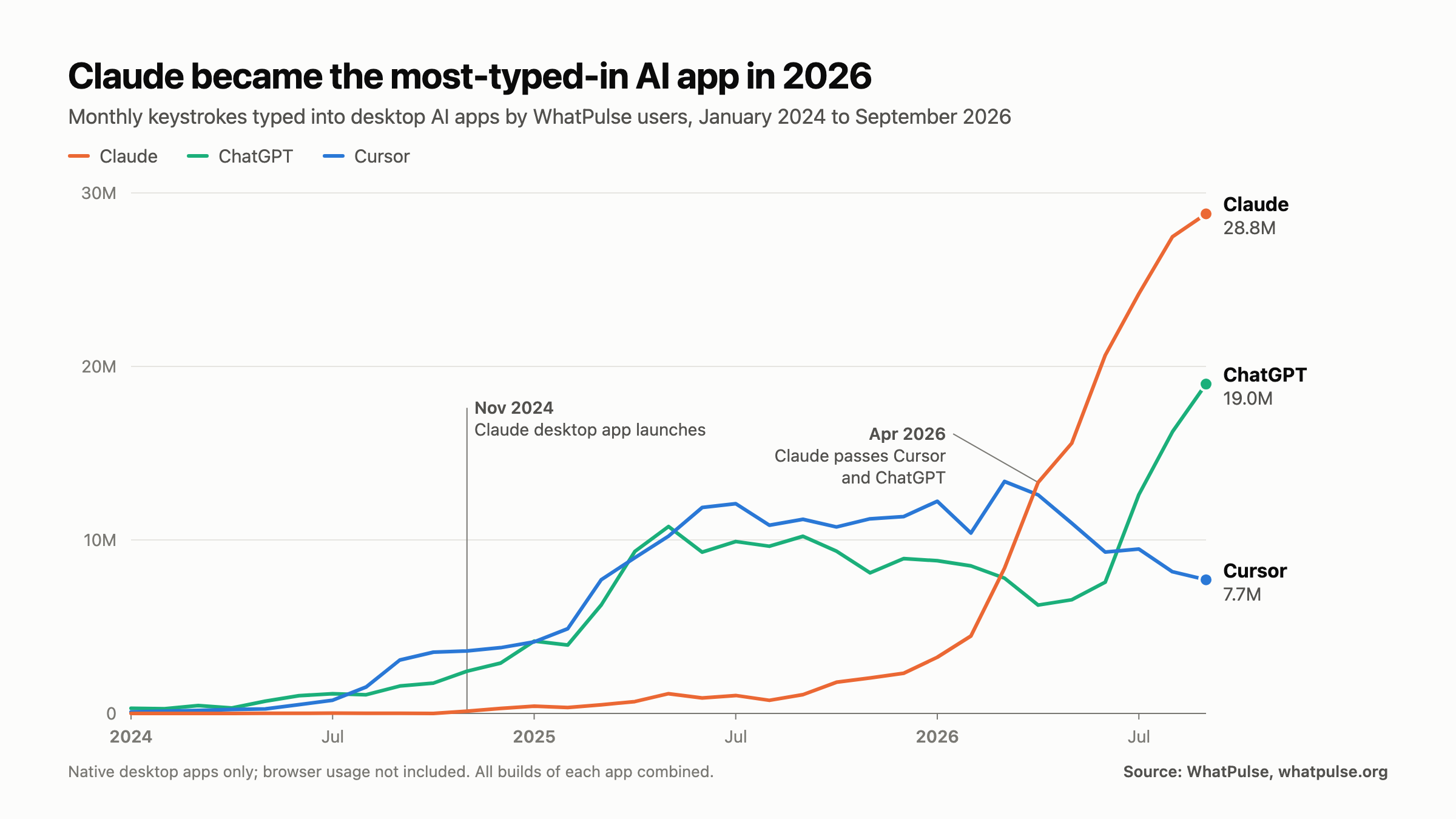
In early 2026, Claude's line goes almost vertical.
| Month | Claude keystrokes | Share of active WhatPulse users in Claude |
|---|---|---|
| December 2025 | 2.3 million | 1.6% |
| February 2026 | 4.5 million | 3.2% |
| March 2026 | 8.4 million | 5.4% |
| May 2026 | 15.6 million | 7.7% |
| September 2026 | 28.8 million | 10.8% |
In nine months, Claude desktop usage grew 12 times. Since its launch month in November 2024, it has grown 215 times. Today, 1 in 9 active WhatPulse users types into Claude every month.
Along the way:
- In March 2026, Claude passed ChatGPT in keystrokes (8.4 million against 7.8 million), and four times as many people installed Claude as ChatGPT.
- In April 2026, Claude passed ChatGPT in reach (7.0% of active users against 5.2%) and Cursor in keystrokes, making it the most-typed-in AI app on WhatPulse.
- By September 2026, Claude accounted for 45% of all keystrokes typed into AI apps.
Claude users don't just open the app, either. In September 2026 they spent an average of 15 hours in it, about half an hour every day.
Developers are moving from AI editors to AI agents
The other big shift in 2026 is happening on developers' desktops.
Cursor peaked in March 2026 at 13.4 million keystrokes, reaching 3.7% of active WhatPulse users. By September 2026 it was down to 7.7 million keystrokes (-42%) and 2.7% of active users. New installs more than halved over the same period.
Cursor didn't collapse. It slid, steadily. The developers who stayed still spend about 14 to 15 hours a month in Cursor, the same as before, but they type around 20% less in that time. We're not the only ones seeing this. In JetBrains' 2026 research on AI coding agent adoption, the share of developers using Cursor at work fell from 18% to 12% between January and mid-2026, even though more developers than ever had heard of it.
At the same time, two things grew fast:
- Claude Code, Anthropic's coding agent, went from almost nobody in October 2025 to 3.4% of active WhatPulse users in September 2026, more than Cursor. You won't see its keystrokes in our data, because people type to Claude Code inside their terminal. But the share of people running it grew faster than any AI editor.
- OpenAI's Codex app appeared in February 2026. By June it reached 5.4% of active WhatPulse users and 13.3 million keystrokes.
The one AI editor still growing is Google's Antigravity, which went from 0.7 million keystrokes in its launch month to 6.1 million in September 2026, close to Cursor's level.
One likely explanation: more and more coding work is being handed to agents that run in the background, while developers type the instructions. Less time spent editing code by hand means fewer keystrokes in the editor.
OpenAI's second wind
ChatGPT's desktop numbers were remarkably flat for a long time. From early 2025 to spring 2026, about 5 to 6% of active WhatPulse users typed into it each month, at 6 to 10 million keystrokes.
In July 2026, that changed. A new ChatGPT desktop app arrived (the previous version shows up as "ChatGPT Classic" in our data), and ChatGPT had its best month for new installs yet, more than double its usual pace. Keystrokes went from 7.6 million in June to 19.0 million in September 2026, and its reach grew to 6.9% of active users.
Over the same months, Codex usage dropped sharply, and in September a ChatGPT installer that bundles Codex appeared in our data. It looks like a lot of Codex usage moved into the ChatGPT app itself.
ChatGPT is growing again, but Claude now reaches about 50% more WhatPulse users and gets about 50% more keystrokes.
Who types the most?
Over the full history, these are the desktop AI apps WhatPulse users have typed into the most:
| App | Total keystrokes | Keystrokes per user | Hours per user | Keystrokes per hour |
|---|---|---|---|---|
| Cursor | 211.4 million | 115,898 | 94.6 | 1,225 |
| ChatGPT | 197.6 million | 75,565 | 37.6 | 2,009 |
| Claude | 175.3 million | 60,963 | 39.1 | 1,558 |
| Codex | 54.1 million | 29,065 | 22.4 | 1,298 |
| Antigravity | 45.8 million | 45,708 | 29.6 | 1,542 |
| Comet | 38.5 million | 47,271 | 59.0 | 801 |
A few things stand out:
- Cursor users spend the most time in it, almost 95 hours on average, and type over 115,000 keystrokes each. An editor is somewhere you work all day, not something you check now and then.
- ChatGPT users type the fastest, at about 2,000 keystrokes per active hour. Chat apps are pure writing: long prompts, follow-up questions, context pasted and edited.
- Claude has reached more WhatPulse users than any other AI app, and at its current pace it will pass Cursor and ChatGPT in lifetime keystrokes soon.
- Comet users spend lots of time but type little, because a browser is mostly for reading.
Local AI: installed, not used much
Local LLM apps like LM Studio and Ollama are a surprisingly common sight: about 4% of active WhatPulse users have one running every month. But they barely type into them, about 3 hours per user over the app's whole lifetime. For most people, running a model locally seems to be an experiment, not a daily tool.
What this means
- AI now has its own place on the desktop. One in five WhatPulse users types into a desktop AI app every month, and that share has grown almost every month for almost three years.
- The leader can change quickly. Cursor led for most of 2024 and 2025. Claude went from third place to first in about three months.
- Coding is moving to agents. AI editors grew first; in 2026, coding agents like Claude Code and Codex are growing faster.
- This is still early. At 1.9% of all keystrokes, AI is a small part of our typing day. The curve says it won't stay small.
See your own AI usage
Curious how much you type into Claude, ChatGPT or Cursor? WhatPulse tracks keystrokes, clicks and time per application, privately and on your own computer. Your dashboard shows exactly which apps get your time, and how that changes month by month.
You can also look up any app's global stats: Claude, ChatGPT, Cursor.
Download WhatPulse and find out how much of your day goes to AI.
Methodology: hourly per-application data from everyone active on WhatPulse each month. Percentages are shares of that month's active users. At this size, a share like 10.8% has a sampling margin of error of about ±0.5 percentage points. WhatPulse users spend more time at a computer than the average person, so read these numbers as an early signal, not a census. Keystrokes are counted, never recorded. All builds and versions of an app are combined into one product. Only native desktop apps are included. AI used in a browser counts as browser usage and is not part of these numbers. Claude Code runs in the terminal, so we report its reach but not its keystrokes. Some usage on computers shared by multiple WhatPulse installs may be slightly undercounted.